Docomomo International Wrap Up
I landed in Los Angeles excited to be back for the second time with a localized experience of the City from my previous, albeit short visit. Walking from Little Tokyo, hopping on the subway, and then resurfacing into stretches that feel built almost entirely around cars made the distance between “modernism” as an idea and modernism as lived environment feel immediate. By the time DOCOMOMO International conference got underway, Los Angeles already felt like a key part of the conference experience providing tangible examples of discussions during sessions and reinforced during the various tours. What follows is less a formal recap than a personal set of notes from the week: the buildings that held my attention, the conversations that kept looping back to the same questions, and a few moments that clarified why DOCOMOMO’s work, and our regional efforts in Ontario, still matters.
In that sense, Los Angeles was an unusually instructive host city. Modern architecture here is scattered across time and geography with downtown containing many later modern-era buildings that track the city’s growth alongside an increasing emphasis on accommodating cars. That history is legible not only in individual landmarks, but also in the experience of moving through the city, where walking can be unexpectedly difficult, even as genuinely walkable districts persist.
The Los Angeles Conservancy’s Modernism tour offered a helpful cross section of buildings and development periods, beginning with the Art Deco Central Library and moving through examples such as the ARCO Plaza (now City National) and the Bonaventure Hotel, before ending with the library’s postmodern addition. Seeing these projects in sequence set up many of the questions that would recur over the following days: what should be preserved, what must be adapted, and how do planning assumptions, especially those tied to mobility and infrastructure, shape both the buildings and the contexts we now inherit?
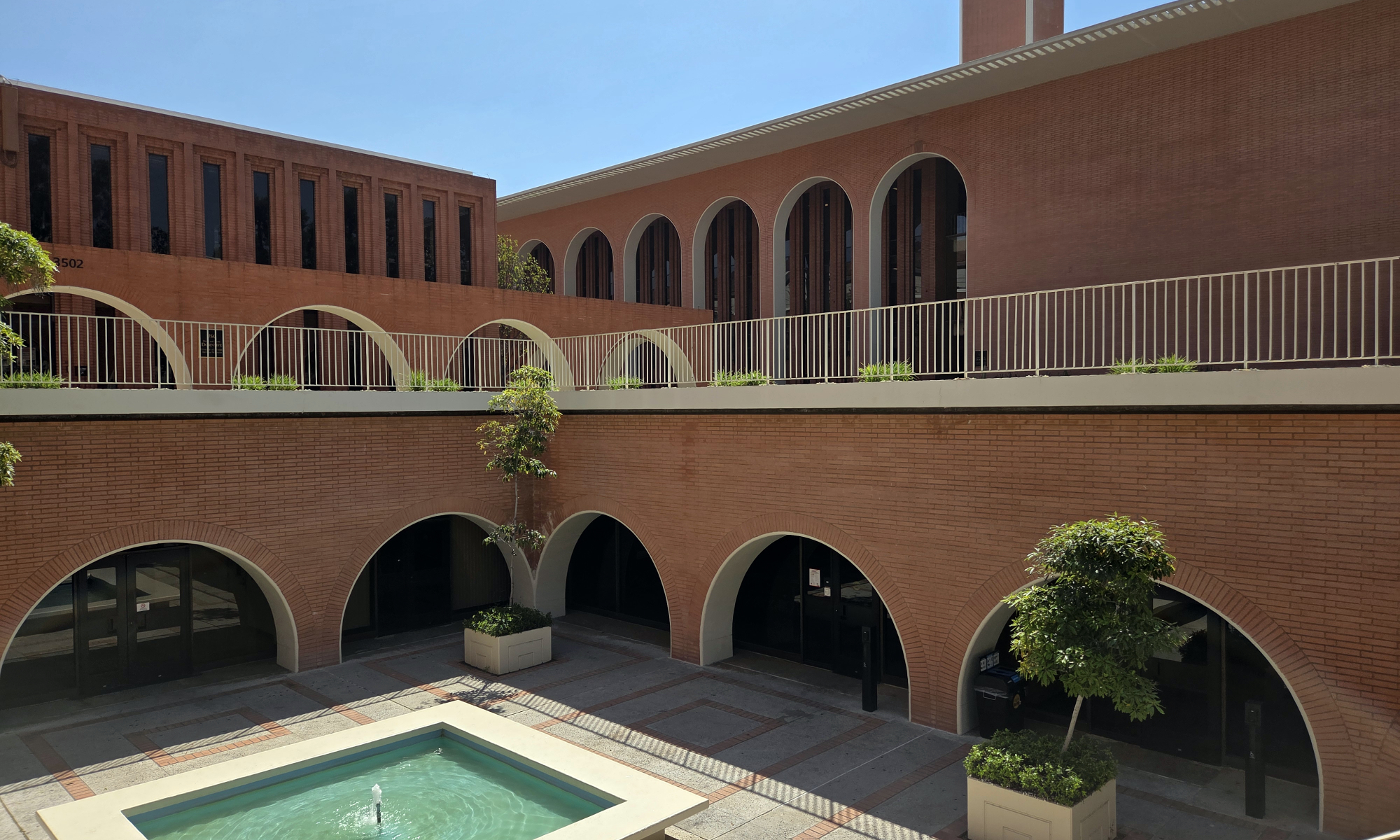
Conference sessions were held at the University of Southern California, across from Exposition Park about a 20-minute subway ride from where I was staying in Little Tokyo. The program itself ranged widely across the practical and conceptual challenges involved in conserving modern places, including rehabilitation strategies, the long shadow of modern planning on conservation decision-making, and the way distinctive materials have shaped equally distinctive building types. Several sessions foregrounded lesser-known international examples of modernism, which helped underline just how varied modern heritage (and conservation practice) can be from place to place.
That sense of expanding scope carried into the first full day’s closing discussion, which took up a timely question: how DOCOMOMO might/should approach the conservation of postmodern architecture. On the second day I attended my first DOCOMOMO International Meeting, where I shared an update on the status of DOCOMOMO Ontario and the efforts we are planning on behalf of the larger organizing committee. The meeting also included the formal announcement that the next international conference will be held in Athens in 2028, and the welcoming of new regional working parties in Uruguay, Bangladesh, and Ethiopia, bringing the total number of working parties to 86.
The conference concluded at the Getty with the closing plenary by Frida Escobedo. I was initially surprised by the choice when I first reviewed the program, but her talk was clear and closely aligned with DOCOMOMO’s mission in unexpected ways. One of her central threads was memory: modern buildings, she argued, can act as vessels of memory and as evidence of time’s passage, even though they are often treated as if they belong to a shorter historical horizon than older places. She also emphasized the need for building-specific strategies when adapting, updating, and rehabilitating modern works. In her examples of on-going work within her Studio, the Centre Pompidou calls for opening up the building and restoring clarity to its original design logic; an act of careful editing supported by strategic enhancements, while the Metropolitan Museum of Art requires weaving together, constructing an addition, and revisiting earlier planning efforts to help “complete” the ensemble. In both cases the approach is tied to the evolution of place, bringing a sense of place-specific clarity and improving how people move through and experience those institutions.
Outside the formal program, my stay in Little Tokyo provided a useful counterpoint to the city’s more car-dominant areas. The neighbourhood is highly walkable, with many small shops and restaurants and easy access to the rest of Los Angeles via the subway. The location made it easy to reach several cultural destinations on foot, including Walt Disney Concert Hall, The Broad, and the Dorothy Chandler Pavilion. The Geffen Contemporary at MOCA was especially close.
Overall, Los Angeles remains a complicated city from an urbanistic perspective. Its reliance on cars (even as some areas change) amplifies the impacts associated with modern planning and modern places; this was especially evident at the Bonaventure Hotel and in the surrounding area, extending into parts of Bunker Hill. The conference reinforced that the considerations involved in conserving modern places are broader and more varied than I had previously assumed, particularly when viewed through international case studies and differing conservation approaches. Organizations like DOCOMOMO remain highly relevant, and the emphasis on regional working parties provides the flexibility needed to recognize and communicate the worldwide variation in modern heritage.
Building on renewed momentum I am interested to see how DOCOMOMO Ontario evolves over the next few years, and what we will be able to share in Athens in 2028.